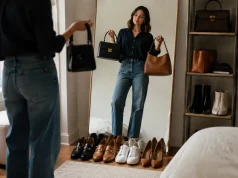

There’s a particular kind of paralysis that strikes right before you leave the house. You’ve got an outfit you like, a bag you love, shoes that feel right and then you look in the mirror and wonder if any of it goes together. So you swap the bag. Then the shoes feel wrong. Twenty minutes later you’re back where you started, running late, slightly irritated.
Most style advice on this topic makes it worse. It hands you a set of rules match leather finishes, keep metals consistent, always coordinate with the darkest piece and those rules feel reassuring until the moment they don’t. The truth is that matching bags and shoes is less about following a formula and more about understanding a few underlying principles that you can bend, break, or build on depending on what you’re actually going for.
Why the “They Must Match” Rule Stuck Around So Long
The expectation that bags and shoes should match ideally in the same color, ideally in the same leather comes from early20th century fashion codes when dressing was more rigidly prescribed. Women’s fashion in particular operated within strict frameworks of propriety, and a matched set communicated social literacy. You knew the rules, you followed them, you belonged.
That’s not the world most people are dressing for now. But the rule persisted because it genuinely is the easiest way to look pulled-together when you’re not sure what you’re doing. Matching removes one variable. If everything in the same color family, you’ve at least got coherence.
The problem is coherence isn’t the same as style. Coherence is a floor, not a ceiling.
Color Relationships That Actually Do the Work
Before you can stop overthinking it, it helps to understand why certain combinations click and others clank. Color is doing most of the heavy lifting here, and it tends to work in three modes.
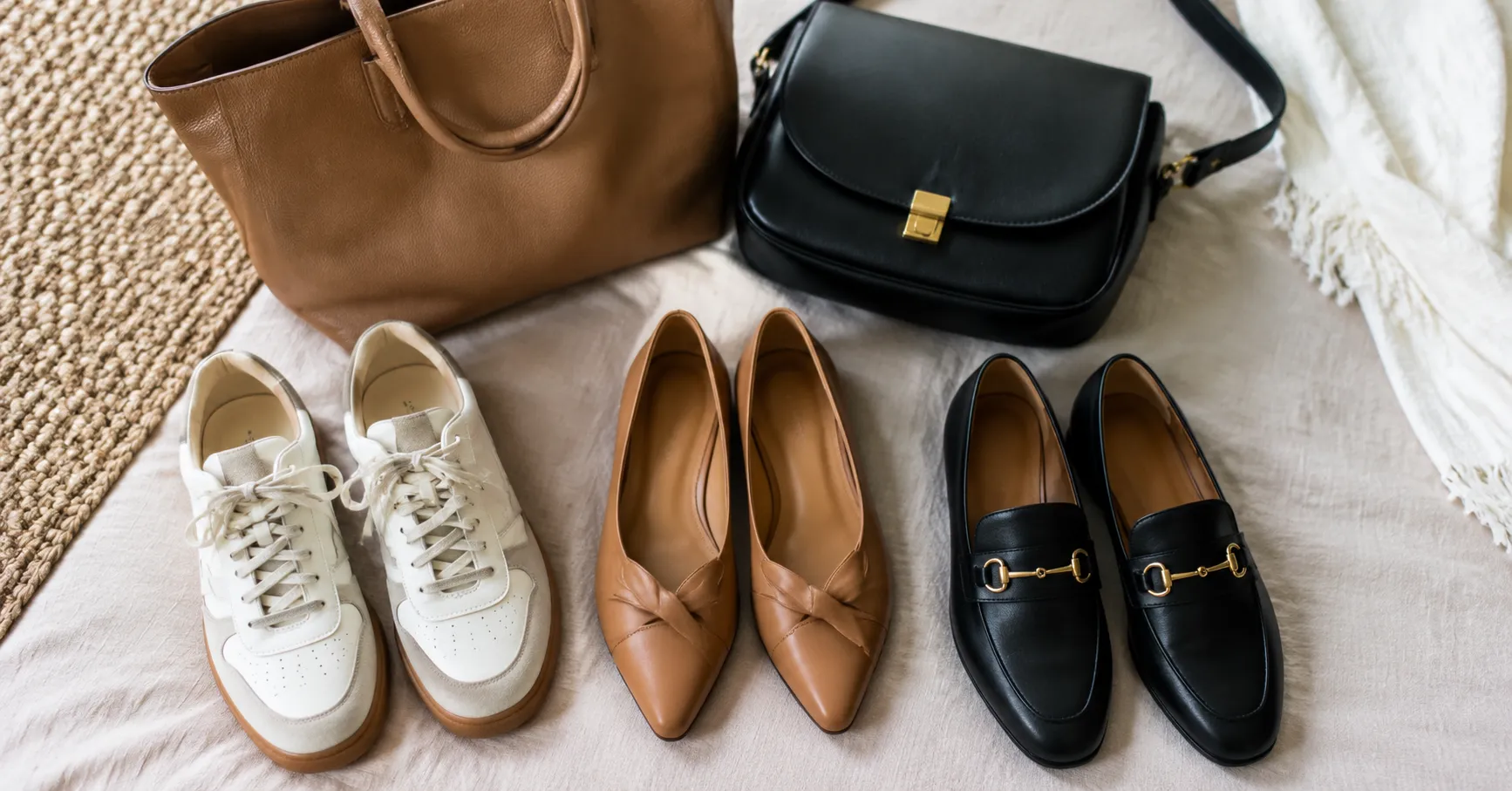
The first is tonal where bag and shoes sit in the same color family but aren’t identical. Tan leather bag, cognac boots. Navy tote, slate-blue loafers. This is the easiest way to feel coordinated without looking matchy. The variation creates a little visual interest while the shared undertone keeps things grounded.
The second is contrast and this is where things open up considerably. A white bag against all-black shoes. A bright red crossbody worn with camel heels. Contrast works because it’s intentional. When two pieces are genuinely different in color and it still looks good, it signals that the person put some thought into it. The secret ingredient here is usually the outfit in between contrast between bag and shoes tends to land better when the clothing connects them, either by picking up one of the colors or by being neutral enough to let both breathe.
The third is what you might call accent-matching, where the bag and shoes share a color that also appears somewhere else in the outfit a detail on a jacket, the color of a belt, even a pattern in a scarf. This is the more advanced version of coordination and when it’s done well, it looks effortlessly put-together in a way that’s hard to pin down.
Material and Texture Are Doing More Than You Think
Color gets most of the attention but texture is often what determines whether an outfit feels cohesive or disjointed. A sleek patent leather pump and a casual canvas tote don’t fight on color but they pull in completely different directions in terms of formality and finish.
This doesn’t mean everything needs to be the same material that would be deeply boring but it does mean thinking about whether your pieces belong to the same register. A structured leather shoulder bag and leather oxford shoes work together not because they’re identical but because they share a sensibility. They’re both a little considered, a little classic. They belong to the same mode of dressing.
The counterpoint to this is intentional mixing: chunky athletic shoes with a sleek mini bag, or delicate strappy sandals with a soft oversized tote. These work because the contrast is so committed it reads as a choice. The failure zone is the middle ground pieces that are neither complementary nor boldly different, just slightly mismatched in energy.
Suede, in particular, is a useful texture to keep in mind. It tends to have a softening effect on whatever it’s near. Suede loafers paired with a suede bag can feelcozy-chic or costume-y depending on the outfit. One suede piece against harder leather or canvas adds warmth without looking studied.
When Matching Feels Mandatory and When It Doesn’t
Context still matters. Not in the sense that there are hard rules, but in the sense that different environments carry different visual grammars.
A formal occasion a wedding, a professional presentation, a dinner that requires you to think about what you’re wearing still rewards more deliberate coordination. Not because rules demand it but because formality is partly about demonstrating that you made effort. Matched or tonally harmonious bag and shoes signal that the outfit was considered as a whole.
In everyday dressing, those constraints basically dissolve. Street style and contemporary casual wear have been riffing on mismatched accessories for years, and the combinations that get noticed aren’t the ones that play it safe. A vintage floral bag with white sneakers and a linen blazer doesn’t require a system. It requires trusting that different things can share space in the same look.
The most consistent principle across all contexts: the more chaotic your outfit, the more grounded your accessories need to be. The simpler your base, the more freedom you have to play with what you carry and what you wear on your feet.
A Few Combinations That Work More Often Than They Should
Leopard print shoes with a black bag is practically a cheat code the pattern reads as neutral in a strange way, and the black grounds it instantly. Metallics in shoes pair with almost any bag color because silver and gold have the useful quality of not really competing with anything. A white bag in summer works with nearly every shoe color, including the ones that technically shouldn’t orange sandals, cobalt loafers, red mules. Something about the brightness of white just absorbs the contrast.
Brown, on the other hand, is more demanding than people expect. Brown shoes with a black bag divides the fashion world neatly into people who think it’s sophisticated and people who think it’s a mistake. The trick, if you want to make it work, is leaning into it rather than hedging dark chocolate brown shoes against a true black bag, not taupe-brown against charcoal. Commit to the contrast or avoid it.
Getting Out of Your Own Way
At some point the most useful thing you can do is dress, look, and stop re-evaluating. The mirror check has a diminishing returns problem. After a certain point you’re not seeing more clearly, you’re just generating doubt.
The people who seem to dress effortlessly aren’t following stricter rules they’ve usually internalized a few principles well enough that the decision-making happens faster, or they’ve simply gotten comfortable enough with their own instincts that they trust the first answer.
Which means the real skill isn’t knowing which bag goes with which shoe. It’s knowing what looks like you, and then letting that be enough.