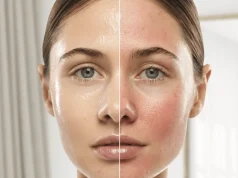


Your skin has been trying to tell you something. That tight, sandpaper feeling after washing your face. The redness that appears out of nowhere. The way your moisturizer stings instead of soothes. These aren’t random annoyances they’re your barrier waving a white flag.
Most people respond by adding more products. More serums, more treatments, more actives. It feels logical: something is wrong, so you intervene harder. But a damaged skin barrier doesn’t need more intervention. It needs you to get out of the way.
Here’s what’s actually happening underneath that irritated surface, and what seven days of intentional recovery actually looks like.
What the Skin Barrier Really Is (And Why It Breaks)
Think of your skin barrier technically called the stratum corneum as a brick wall. The skin cells are the bricks. The lipids, ceramides, and fatty acids between them are the mortar. When that mortar erodes, the wall starts letting things in that shouldn’t get in: pollutants, bacteria, allergens. And it starts letting things out that should stay in: moisture.
The barrier breaks down faster than most people expect. Over-exfoliation is the most common culprit, especially now that acids and retinoids are everywhere. Using a vitamin C serum, an AHA toner, and a retinol in the same routine isn’t sophisticated skincare it’s a stress test your barrier will eventually fail. Harsh cleansers that strip the skin’s natural oils, hot water, dry indoor air, and even psychological stress (which elevates cortisol and disrupts lipid production) all chip away at the mortar over time.
The cruel irony is that a compromised barrier makes every other skin issue worse. Acne bacteria penetrate more easily. Hyperpigmentation triggers more readily. Sensitive skin becomes hypersensitive. You can’t treat anything effectively on a broken foundation.
Day 1 and2: The Purge (Removing What’s Hurting You)
The first instinct is to find the right product to fix this. Resist it. The actual first step is subtraction.
Pull everything active from your routine. That means exfoliating acids (glycolic, lactic, salicylic), retinoids, vitamin C, niacinamide in high concentrations, benzoyl peroxide, and anything with fragrance synthetic or natural. Essential oils are not gentle just because they’re natural. Rose hip oil on a reactive barrier is like pouring lemon juice on a papercut.
What you’re left with should be almost embarrassingly simple. A gentle, low-pH cleanser with no sulfates. A bland moisturizer. Sunscreen in the morning. That’s it. The goal of these first two days is to stop the bleeding metaphorically speaking by eliminating every potential irritant.
Some people feel immediate relief. Others feel worse before they feel better, especially if their skin has become dependent on the stimulation of actives. This is normal. The discomfort is not a sign that you need to add something back.
Days 3 Through 5: Feeding the Barrier Back to Life
Now that you’ve stopped the damage, you can start the rebuild. The barrier is made of lipids, so you repair it with lipids.
Ceramides are the most important ingredient in this phase. They’re the dominant lipid in the stratum corneum and the first thing depleted by over-exfoliation. A ceramide-rich moisturizer applied while skin is still slightly damp after cleansing creates the optimal environment for absorption. Look for ceramides listed alongside cholesterol and fatty acids this trio works synergistically in a ratio that mirrors the skin’s natural composition.
Occlusives matter here too. Products containing petrolatum, squalane, or shea butter don’t repair the barrier directly, but they create a physical seal that prevents further moisture loss while the repair happens underneath. The slugging trend applying a thin layer of petrolatum as the final step at night became popular for exactly this reason. It’s not a miracle. It’s just physics.
Hyaluronic acid can help if your environment has reasonable humidity. In very dry air, though, humectants without an occlusive on top will pull moisture from deeper skin layers rather than from the environment, which makes things worse. Layering matters: humectant first, emollient second, occlusive on top if needed.
Water temperature during cleansing deserves attention during this window. Hot water dissolves the lipid barrier. Lukewarm, verging on cool, is what your skin actually wants.
The Ingredient You’re Probably Overlooking
Panthenol (provitamin B5) doesn’t get the cultural cachet of ceramides or hyaluronic acid, but research on it is quietly impressive. It penetrates the skin, converts to pantothenic acid, and accelerates wound healing at the cellular level. It also has strong humectant properties and reduces inflammation. For a damaged barrier, it’s doing multiple jobs simultaneously.
Oat extracts specifically colloidal oatmeal are another underestimated tool. The FDA recognizes colloidal oatmeal as a skin protectant, and the avenanthramides it contains have measurable anti-inflammatory effects. Products built around these ingredients don’t have compelling marketing stories, which is probably why they get overlooked in favor of more dramatic actives. But unglamorous and effective is exactly what a compromised barrier needs.
Days 6 and 7: Assessing Before You Reintroduce
By day six, most people start feeling restless. The skin looks calmer, the tightness is easing, and the instinct is to get back to the good stuff the retinol, the exfoliants, the brightening serums.
Slow down here. Two days of feeling better doesn’t mean the barrier is fully repaired. The cell turnover cycle that restores the stratum corneum takes closer to four weeks. What you’re seeing on the surface by day six is a reduction in inflammation, not complete structural repair.
Use these last two days to observe rather than act. Is your moisturizer absorbing without stinging? Can you use sunscreen without redness? Does your skin feel neutral neither tight nor greasy after cleansing? These are functional signs that the barrier is rebuilding, not just aesthetic ones.
If any of those still feel off, the honest answer is that your seven-day timeline needs to extend. Some barriers, particularly those damaged over months or years of aggressive routines, need three to four weeks of this minimal approach before they’re ready for anything active again.
Reintroducing Actives Without Breaking What You Fixed
When you do start adding things back, the principle is one ingredient at a time with at least a week between introductions. Start with the lowest concentration available. Apply only every third night before building frequency.
The testing method matters: apply a new product to the same small area for three to four consecutive days before using it on your full face. This surfaces sensitivities before they become full-face reactions. It’s tedious. It’s also the only way to know with confidence what your skin can actually handle.
Exfoliation, when it returns, should look different than before. Once a week, enzyme-based or very low-concentration AHA, never alongside other actives in the same routine. The aggressive twice-daily approach that damaged things in the first place isn’t something you return to it’s something you redesign away from.
The Mindset Shift That Makes the Difference
A seven-day repair is realistic as a starting point, not a guarantee. But what usually determines whether someone’s barrier stays healthy after recovery isn’t the specific products they use it’s whether they’ve changed the underlying philosophy.
The skin is not a problem to be solved with enough inputs. It’s a system that functions best when it’s not constantly overwhelmed. The people who see lasting results aren’t always using the most sophisticated routines. They’re using fewer things with more consistency, and they’ve learned to read their skin rather than follow a rigid protocol regardless of what their skin is telling them.
That tightness after cleansing? Still a white flag. Now you know what to do when you see it.