

Before Words, There Were Objects
Long before anyone wrote a law or carved a decree into stone, people had already figured out how to say “I matter more than you” without opening their mouths. They did it with things they wore.
The oldest known jewelry a set of perforated shell beads found in Morocco dates back roughly 142,000 years. No one can say for certain why early humans drilled holes through shells and strung them together, but the behavior itself tells us something: we have always felt the need to mark ourselves. To signal something about who we are, where we come from, or what we’ve earned. The shell bead wasn’t decoration in the casual sense we use that word today. It was communication. Possibly the first kind we ever had.
What happened over the millennia since is really a story about that original impulse getting more elaborate, more codified, and eventually more contested.
The Grammar of Gold
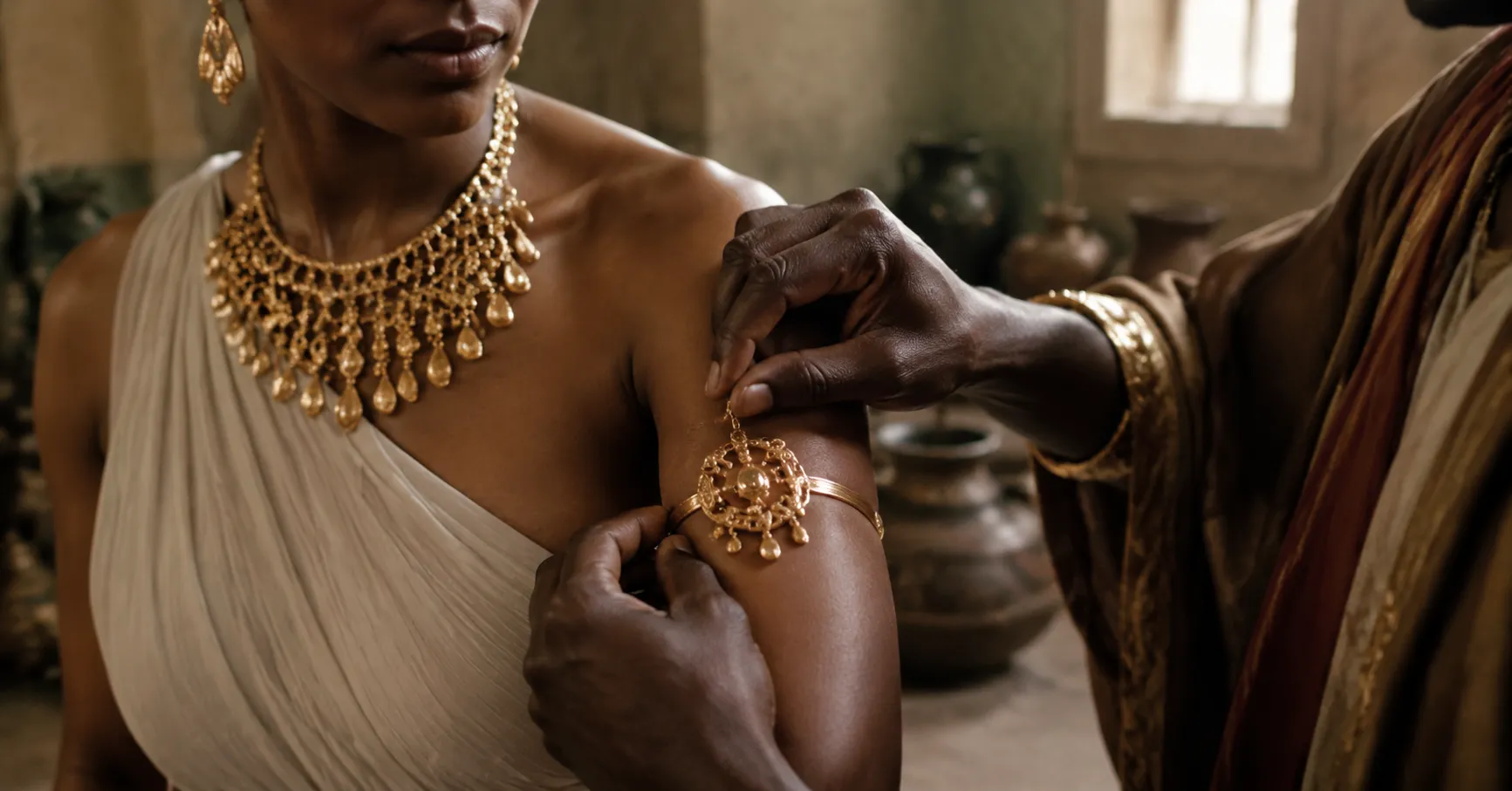
Every civilization that developed a surplus eventually developed a jewelry culture, and almost every jewelry culture became entangled with hierarchy. In ancient Egypt, the materials themselves were a kind of grammar. Gold, which Egyptians associated with the flesh of the gods, was strictly controlled. Pharaohs wore it in quantities designed to make them look less like people and more like divine phenomena. Priests wore it in forms that marked their proximity to the sacred. Common Egyptians wore faience a glazed ceramic material that mimicked the look of turquoise and gold without the substance. The copy was acceptable. The real thing was a boundary.
Mesopotamia worked similarly. Sumerian burial sites from around 2500 BCE reveal stratified graves: royalty interred with headdresses of hammered gold and lapis lazuli imported from thousands of miles away, servants buried nearby with considerably less. The lapis lazuli alone is significant. It had to travel from what is now Afghanistan to reach Ur. The logistics of acquiring it communicated something before the object was even finished.
This is the core mechanism: scarcity made visible. Jewelry worked as status precisely because its materials were difficult to get, time-consuming to craft, and therefore impossible for most people to own. Wearing it wasn’t vanity. It was proof.
When Sumptuary Laws Made It Official
At some point, the logic shifted from organic to enforced. Societies stopped relying on the natural scarcity of precious materials to sort people out and started writing rules. Sumptuary laws regulations governing what different classes of people could wear appear across Roman history, medieval Europe, feudal Japan, and Ming dynasty China with remarkable consistency.
Rome, for instance, repeatedly restricted who could wear purple-dyed garments or gold rings. The gold ring was specifically a marker of the equestrian class, and when wealthy freedmen began wearing them, the Senate tightened the rules. It wasn’t just aesthetic snobbery. The ring was doing legal and social work. It told anyone who saw you what protections you had, what courts you could access, what your word was worth in a dispute.
Medieval Europe went further. English sumptuary laws passed in the 14th century specified not just materials but weights how many ounces of gold a knight’s wife was permitted to wear versus a merchant’s wife. The merchant might actually be richer. That was precisely the problem. When money began to circulate more freely than lineage could account for, the old visual hierarchy started to break down. Laws became the stopgap.
What these laws reveal is that jewelry’s power was never purely about beauty or wealth. It was about legibility. A functioning hierarchy needs its members to be readable. When jewelry started telling the wrong story when a craftsman’s daughter could wear pearls indistinguishable from an aristocrat’s the whole system felt threatened.
The Renaissance and the Rise of the Statement Piece
By the 15th and 16th centuries in Europe, something interesting had shifted. The Renaissance created a new class of patron educated, urban, commercially successful who wanted to project sophistication, not just bloodline. Jewelry became less about marking inherited rank and more about performing a kind of cultured identity.
Portraits from this period are essentially jewelry catalogs. Hans Holbein’s subjects drip with chains, pendants, and rings. Henry VIII had himself painted in ways that made his jewels nearly as prominent as his face, and that wasn’t coincidence the image was political propaganda, and the jewelry was part of the argument. A massive ruby set in a collar doesn’t just say “I am rich.” It says “I can mobilize armies, command loyalty, and outlast anyone who challenges me.”
What the Renaissance also introduced was the concept of the jewel as an aesthetic object worthy of discussion on its own terms. Goldsmiths became celebrated artists. Benvenuto Cellini wrote an autobiography a goldsmith who thought his life story was worth reading. The status encoded in jewelry began to include cultural capital alongside material wealth, a distinction we still navigate today.
Diamonds and the Modern Manufacturing of Desire
Nothing demonstrates how thoroughly jewelry status can be engineered quite like the diamond engagement ring. Diamonds were not always the default symbol of romantic commitment. In the late 19th century, De Beers controlled most of the world’s diamond supply and faced a crisis: their stockpiles were enormous, and demand wasn’t keeping pace. What followed was one of the most effective marketing campaigns in history.
The “A Diamond Is Forever” slogan launched in 1947 did something conceptually brilliant: it fused the diamond’s physical hardness with emotional permanence, then attached that fusion to a specific life ritual marriage. Within a generation, the diamond engagement ring shifted from being one option among many to being the only acceptable symbol of serious romantic intent. To propose without one was to signal either poverty or insufficient feeling, and the two became difficult to distinguish in the cultural imagination.
The formula borrowed from ancient logic scarcity, durability, rarity but applied it through advertising rather than law or divine mandate. The result was the same: a piece of jewelry became a threshold object. You either crossed it or you didn’t, and everyone knew which side you were on.
Subversion as Its Own Status Game
There’s a counternarrative that runs alongside all of this, and it’s worth taking seriously. Throughout history, jewelry has also been used to signal resistance, group membership, or values deliberately opposed to dominant hierarchies.
Punk culture weaponized safety pins and cheap hardware. Hip-hop transformed gold chains long a symbol of old-money European wealth into something that expressed Black American prosperity with its own distinct swagger, deliberately maximal, impossible to mistake for understated WASP refinement. LGBTQ communities have used specific symbols and stones to signal identity to those who knew how to read them, sometimes for safety, sometimes for solidarity.
The subversion always borrows the underlying grammar. It still uses visible objects to communicate social meaning, still relies on the idea that what you wear tells others who you are and where you stand. The message changes. The mechanism doesn’t.
What the Language Has Become
Today the grammar of jewelry is more fragmented and contested than it’s ever been. A Cartier Love bracelet and a handmade clay bead bracelet can signal status, just different kinds. One says institutional luxury and access to a specific tier of consumer culture. The other might say something about authenticity, sustainability, or intentional simplicity values that in certain circles carry their own considerable social weight.
Logomania, quiet luxury, heritage pieces, artisanal craft these are all competing dialects within the same language. What they share is the original function: making inner states and social positions visible through what gets placed on the body.
The question jewelry has always asked, underneath all its beauty and sparkle, is a quiet, persistent one. It asks: who are you, and how do you want to be seen?
The answer keeps changing. The question never does.