
When Comfort Stopped Apologizing
There’s a moment most of us remember standing in front of a mirror, wearing sweatpants, wondering if we looked like we’d given up. That quiet guilt was the fashion industry’s doing, years of conditioning that treated comfort as the enemy of style. But somewhere in the early2010s, the walls started coming down. Athletes wore their practice gear to coffee shops. Supermodels were photographed in joggers outside Paris shows. What we used to call “lazy” had quietly rebranded itself into something aspirational.
Athleisure didn’t just blur the line between gym and street. It dismantled the entire premise that you had to choose. And now, nearly a decade into that cultural shift, the conversation has matured. It’s no longer enough to simply wear sweatpants outside the house. The question people are actually asking stylists, editors, and anyone who pays attention to what they’re putting on their body is how to wear them with intention.
That’s where the belt bag enters. Not as a trend accessory, but as a structural solution to a very real aesthetic problem.
The Geometry Problem Sweatpants Create
Sweatpants, by design, fall straight. The waistband sits wherever it sits, the fabric drapes without architecture, and the silhouette tends to read as soft, unstructured, even a little formless. For some outfits, that’s exactly the point. But when you’re trying to build a look that communicates something ease without carelessness, movement without sloppiness that lack of definition becomes a challenge.
A belt worn at the waist creates a visual anchor. It interrupts the vertical flow, draws the eye to the midsection, and instantly suggests that thought was applied to the outfit. But a traditional belt on sweatpants looks wrong in a way that’s hard to articulate but immediately obvious. It’s too rigid, too structured for fabric that’s asking to be left alone.
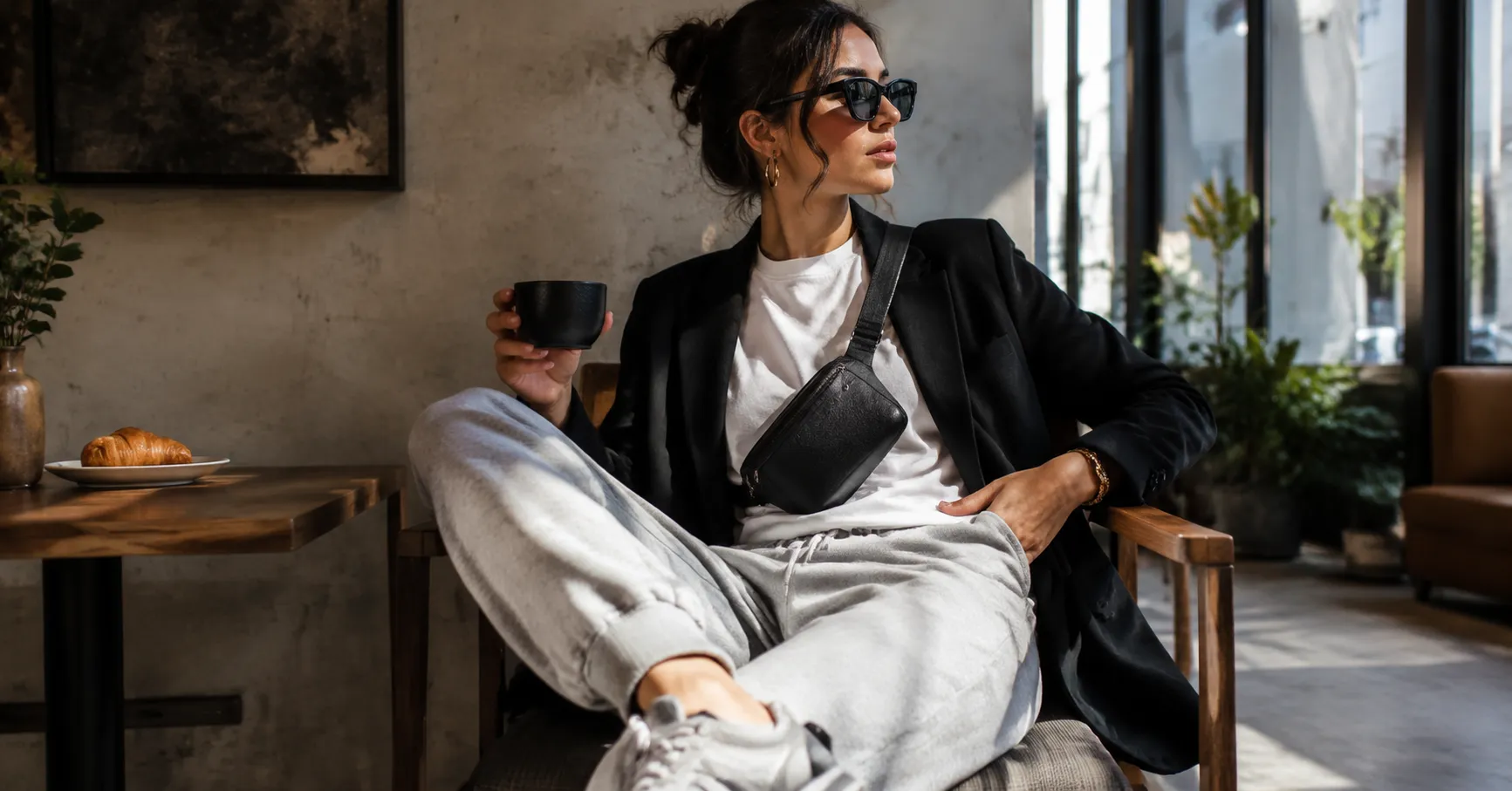
The belt bag solves this quietly. It creates that same visual anchor without piercing the fabric or forcing formality. Worn cross-body, it introduces diagonal lines that add dynamism to an otherwise vertical silhouette. Worn at the hip, it shifts the weight of the look downward, balancing a loose top. Cinched around the waist over a hoodie, it becomes the defining element of an entire outfit the thing that makes you look like you planned it, even if you didn’t.
Proportions Are Everything, and Most People Get Them Wrong
The most common mistake is reaching for the biggest bag in the collection. There’s an instinct to compensate for the casualness of sweatpants with a bag that feels substantial, that says something. What a oversized belt bag actually does is compete with the silhouette, adding bulk where there’s already softness, and the whole thing collapses into shapelessness.
Smaller bags compact rectangles, sleek half-moon shapes, minimalist zip pouches work with sweatpants because they act as punctuation rather than a full sentence. A slim bag at the hip doesn’t announce itself. It simply completes the look in the way a well-chosen shoe does: you might not notice it consciously, but you’d notice immediately if it were wrong.
That said, there are moments when a slightly larger bag earns its place. A wide-leg, high-waisted sweatpant in a structured fabric think heavy fleece or a ponte-blend athletic pant has enough presence to support more visual weight. In that context, a roomy belt bag worn loosely at one hip can actually function as a counterbalance, making the whole outfit feel considered rather than casual.
The read: proportional awareness is the invisible skill that separates a thrown-together look from one that photographs well and holds up in person.
Material Conversations
There’s a tension built into the combination of sweatpants and a belt bag that’s worth leaning into rather than trying to resolve. Sweatpants speak the language of softness cotton, fleece, jersey, terry cloth. Belt bags come in leather, nylon, canvas, coated fabric. These aren’t the same material vocabulary, and the contrast is part of what makes the pairing work.
A smooth leather belt bag against a brushed fleece sweatpant creates a textural dialogue that elevates both pieces. The leather looks less corporate without a formal outfit to contextualize it; the sweats look more intentional with a material that signals quality nearby. It’s a similar principle to why raw denim and a worn linen shirt work together contrast, when it’s calibrated, reads as style.
Nylon bags offer a different kind of elevation. Technical, almost utilitarian, they reinforce the athletic lineage of sweatpants while adding an edge of functionality that feels genuinely modern. A quilted nylon belt bag, the kind that borrows design DNA from outdoor gear, worn cross-body over a monochrome sweatsuit is one of those combinations that looks effortlessly sharp precisely because it’s not trying to look dressed up.
Avoid canvas in almost every context here. Canvas belt bags tend to read as too casual even against an already casual base, pushing the whole look past relaxed and into sloppy. The exception is heavily structured canvas with visible hardware that kind of construction carries enough weight to hold its own.
Color Logic That Actually Makes Sense
The easiest path is tonal dressing: matching or near-matching your belt bag to the color of your sweats. This works reliably, it photographs well, and it requires almost no thought. But it’s also the most minimal version of what this combination can do.
The more interesting territory is in strategic contrast. A charcoal grey sweatpant with a deep cognac belt bag. Navy sweats with an off-white or cream bag. A camel or oatmeal sweatpant with a rich burgundy accessory. These pairings work because they follow a simple rule the bag should either blend into the palette or be the single point of color. What creates visual noise is a bag that partially matches, almost coordinates but doesn’t quite commit.
Black sweatpants are the most versatile base in this entire conversation. They accept almost any belt bag color without conflict and create a clean ground against which even subtle material contrasts read clearly. If you’re building your first intentional athleisure look, starting with black sweats and a bag in any neutral leather tone gives you a combination that’s genuinely hard to get wrong.
Wearing It The Actual Mechanics
How you carry the bag shifts the register of the entire look, and this part is underappreciated. Cross-body, positioned at hip height, gives the outfit a casual athleticism it reads like someone who’s moving through the city, functional and unfussy. That positioning also works to lengthen the torso visually, which is a useful effect when wearing a cropped or fitted top with looser bottoms.
Worn strictly at the waist, the belt bag functions more like a structural garment accessory. This position works best with wide-leg or straight-cut sweats and a more minimal top, because the bag itself becomes a focal point. It’s a slightly more intentional, fashion-forward read closer to how you’d see it styled in a lookbook than on a gym commute.
The front-centered position bag worn flat against the stomach is the choice that reads most explicitly athleisure. It’s sporty, direct, and a little bold. For this to land, everything else in the outfit needs to be clean and uncomplicated. Busy sweatpants, or anything with heavy graphics and a front-centered belt bag, will fight each other. But with a clean silhouette, it commits fully to the aesthetic without apology.
The Deeper Point About Dressing With Intention
There’s a reason this particular combination sweatpants, belt bag keeps appearing in street style, on designers’ personal Instagram accounts, on the people who spend a lot of time thinking about clothes. It isn’t about proving that comfortable things can look expensive, or that casual wear has finally been legitimized. Those arguments already happened. They’re settled.
What people are actually doing now, consciously or not, is asking a more interesting question about how to live in their clothes how to move through a day that might include a morning walk, a meeting, an errand, an early dinner without changing, without layering on a performance of formality that doesn’t match how life actually runs anymore. The belt bag, practical by design, carrying your phone and keys and whatever else without requiring you to carry anything, is part of that same project. It pulls its weight. It earns its place in the outfit.
That’s the thing about the right accessory in the right context. It doesn’t just elevate the clothes. It makes you feel like someone who knows exactly what they’re doing which, when you’re in sweatpants, is a quietly powerful thing to feel.