

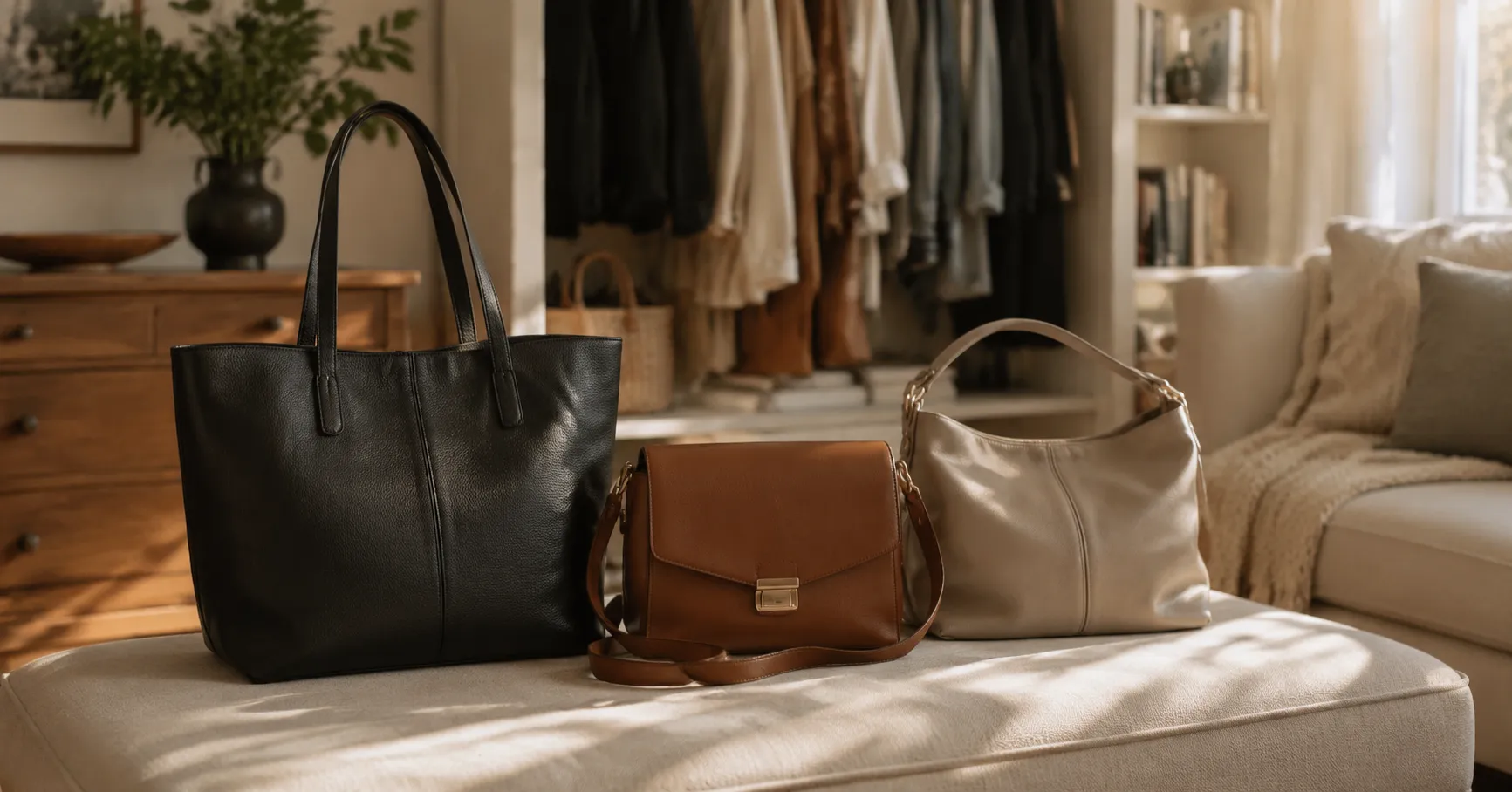
There’s a particular kind of exhaustion that comes from standing in front of a closet full of bags and feeling like you have nothing to carry. A woven straw tote from that beach trip three summers ago. A crossbody you bought on impulse because the hardware was gold and the price was right. A clutch that’s been to exactly one wedding. A backpack from a phase you’re not sure you’re still in. And somewhere underneath all of it, the one you actually reach for every morning.
The capsule wardrobe philosophy has been applied to clothing for decades now, but bags tend to get left out of the conversation. Maybe because they feel more personal, more tied to mood or occasion. But the same logic applies maybe more powerfully, because a bag does something a blouse can’t. It travels with your entire outfit. It frames how you move through a room. It carries the weight of your actual life, sometimes literally.
The premise here isn’t minimalism for its own sake. It’s precision. Three bags that don’t justcoexist in your wardrobe but actively work together, covering the full range of your life without redundancy. The goal is a lineup where nothing is wasted and nothing is missing.
The Structured Tote: Where Practicality Becomes a Power Statement
Start with the bag that does the most work, because it should also be the one that asks the most of you in terms of quality.
A structured tote and the word structured matters here is the workhorse of a thoughtful wardrobe. Not a canvas grocery tote, not a soft hobo that slumps and swallows everything inside it. A tote with enough internal architecture to hold its shape when set down, with a silhouette that reads as intentional rather than convenient.
What makes this bag earn its place isn’t volume, though it will carry plenty. It’s the way it translates across contexts. The same tote that carries a laptop and a change of shoes to the office can carry a bottle of wine and a hardback novel to a weekend gathering. It moves between worlds without announcing the transition, which is exactly what the best wardrobe pieces do.
Color is where most people make their first mistake with this bag. The instinct is to go neutral beige, camel, or black and that instinct is often right, but for the wrong reasons. The goal isn’t to be forgettable. The goal is longevity. A warm tan leather tote in a classic silhouette doesn’t disappear into your outfit; it grounds it. It reads as considered. A black structured tote does the same, with a slightly cooler, more urban register.
What to look for: clean seams, minimal external hardware that could scratch or snag, a bottom that holds its shape, and a closure that actually closes. Interior organization matters more than people admit one internal zip pocket is the difference between a bag you love and one you tolerate.
This is the bag worth investing in. Not because price equals quality in any automatic sense, but because this is the piece that will be touched, seen, and judged every single day. It ages in front of an audience.
The Crossbody: The One That Goes Where You Go
If the structured tote is your weekday anchor, the crossbody is your freedom.
There’s a specific kind of ease that a hands-free bag creates not just physical ease, though that’s real, but psychological ease. When your bag isn’t something you’re managing, you’re more present. You’re not setting it down and picking it up, not shifting it from shoulder to shoulder when it gets heavy. It’s just there, doing its job, letting you do yours.
The crossbody earns its capsule spot because it covers the terrain that the tote doesn’t. Weekends. Travel. Evenings out that aren’t formal enough for a clutch but too casual for a full-sized bag. The moment when you’re running one errand and don’t want to bring everything you own.
Size is the critical variable here, and the range is wider than people think. A crossbody can be slim and envelope-shaped barely bigger than a phone, a card holder, and a key or it can be substantial enough to carry a paperback, a water bottle, and a full set of headphones. What it shouldn’t be is so large that it loses the point. The crossbody lives and dies by its proportionality to the body and the moment.
The best version of this bag has an adjustable strap. Long enough to wear messenger-style when you need the range of motion; short enough to wear tucked under your arm when you want a more polished look. That adaptability is the whole game.
In terms of color and material, this is the bag where you have the most room to express something. Your tote is doing heavy lifting in the visibility department; your crossbody can afford a little personality. A deep burgundy, a cognac leather, even a carefully chosen print these work here in a way they might not in your primary bag. Just ensure it still functions with the broader palette of your wardrobe rather than against it.
The Clutch: Small Bag, Outsized Presence
The case for a clutch in a three-bag capsule is this: there are moments in a life dinners, ceremonies, evenings where the dress says everything and the bag should say almost nothing where no other bag will do.
A crossbody at a black-tie event is a distraction. A tote at a cocktail party is an anchor. The clutch exists precisely for the situation where every other option is wrong, and those situations come up more often than people expect. More importantly, showing up with the right bag in those moments communicates something effortless and assured that no amount of styling otherwise can manufacture.
The ideal clutch for a capsule wardrobe is neutral and frameless. Not bejeweled, not excessively structured, not so trendy that it dates itself by next season. A slim envelope clutch in black, ivory, or a metallic that reads as neutral rather than flashy something like a brushed gold or warm silver can move across almost any formal occasion without calling attention to itself.
The practical consideration that gets overlooked: can you actually hold it? A clutch tucked under your arm should stay there without requiring active concentration. Too large and it becomes unwieldy; too small and there’s nothing to grip. The sweet spot is something roughly the size of a hardback book, maybe slightly slimmer.
Some people argue for a chain-strap option that can convert between clutch and shoulder bag and that flexibility is genuinely useful, though it sometimes compromises the clean lines that make a clutch feel special. If you’re drawn to the convertible style, make sure the chain is removable and doesn’t leave hardware holes that cheapen the silhouette when worn as a true clutch.
The Logic Beneath the Three
What makes this trio work isn’t just the coverage it’s the absence of overlap. Each bag occupies its own distinct territory. The tote handles daily life at full capacity. The crossbody handles mobility and ease. The clutch handles ceremony. Nothing competes with anything else.
The common failure in wardrobe-building bags included is buying variations rather than complements. Two structured totes in different colors. Three crossbodies in slightly different sizes. Multiple clutches for multiple events that are, when examined honestly, the same event. That approach doesn’t create versatility. It creates clutter with extra steps.
The harder discipline is identifying what you actually need versus what appeals to you in the moment. A beautiful bag is a beautiful bag; that’s worth acknowledging. But beauty that duplicates function you already have is just an acquisition, not an addition.
There’s also the question of what gets used. Most people, if they tracked themselves honestly for a month, would find that two or three bags carry ninety percent of their life. The capsule approach simply makes that reality intentional formalizes what’s already true, removes the noise around it, and gives you permission to invest more deeply in less.
Three bags sounds like a constraint. In practice, it feels like clarity. The moment you stop choosing between seventeen options and start trusting three well-chosen ones, getting dressed gets quieter in the best possible way. And quiet, in a wardrobe, is almost always the sound of something working exactly right.