
There’s a moment most of us have experienced standing in front of a mirror, holding a necklace up to our collarbone, feeling like something is slightly off but not quite knowing why. The piece itself is beautiful. The craftsmanship is there. But against your skin, it goes flat. It doesn’t sing. You put it back in the box and move on, quietly unsatisfied.
That friction has a name, and it’s simpler than you might think. Skin tone compatibility. Not in the superficial sense of “this color looks nice,” but in the optical and psychological sense of how metals, stones, and finishes either harmonize with your complexion or quietly fight against it. Once you understand the underlying logic, jewelry shopping and wearing changes completely.
The Difference Between Skin Tone and Undertone
Most people collapse these two concepts into one, which is exactly where the confusion starts. Your skin tone is what you see on the surface fair, light, medium, tan, deep. Your undertone is the subtle hue beneath that surface layer, and it doesn’t shift with a summer tan or a winter pallor. It stays constant.
Undertones generally fall into three families: warm (yellow, peachy, golden), cool (pink, red, bluish), and neutral (a blend of both, with no dominant pull in either direction). The easiest way to identify yours is the classic vein test look at the underside of your wrist in natural light. Blue or purple veins suggest a cool undertone. Greenish veins lean warm. A mix of both? You’re likely neutral, which is honestly the most flexible position to be in.
Another quick tell: think about whether you look better in stark white or off-white. Cool undertones tend to be flattered by bright, clean white. Warm undertones usually glow in cream, ivory, or ecru. This same principle, applied to metal and stone, becomes your compass for jewelry.
Gold, Silver, and Everything In Between
The gold-versus-silver debate is the first thing most people encounter, and the stakes feel higher than they should. But the reasoning is actually elegant once you see it.
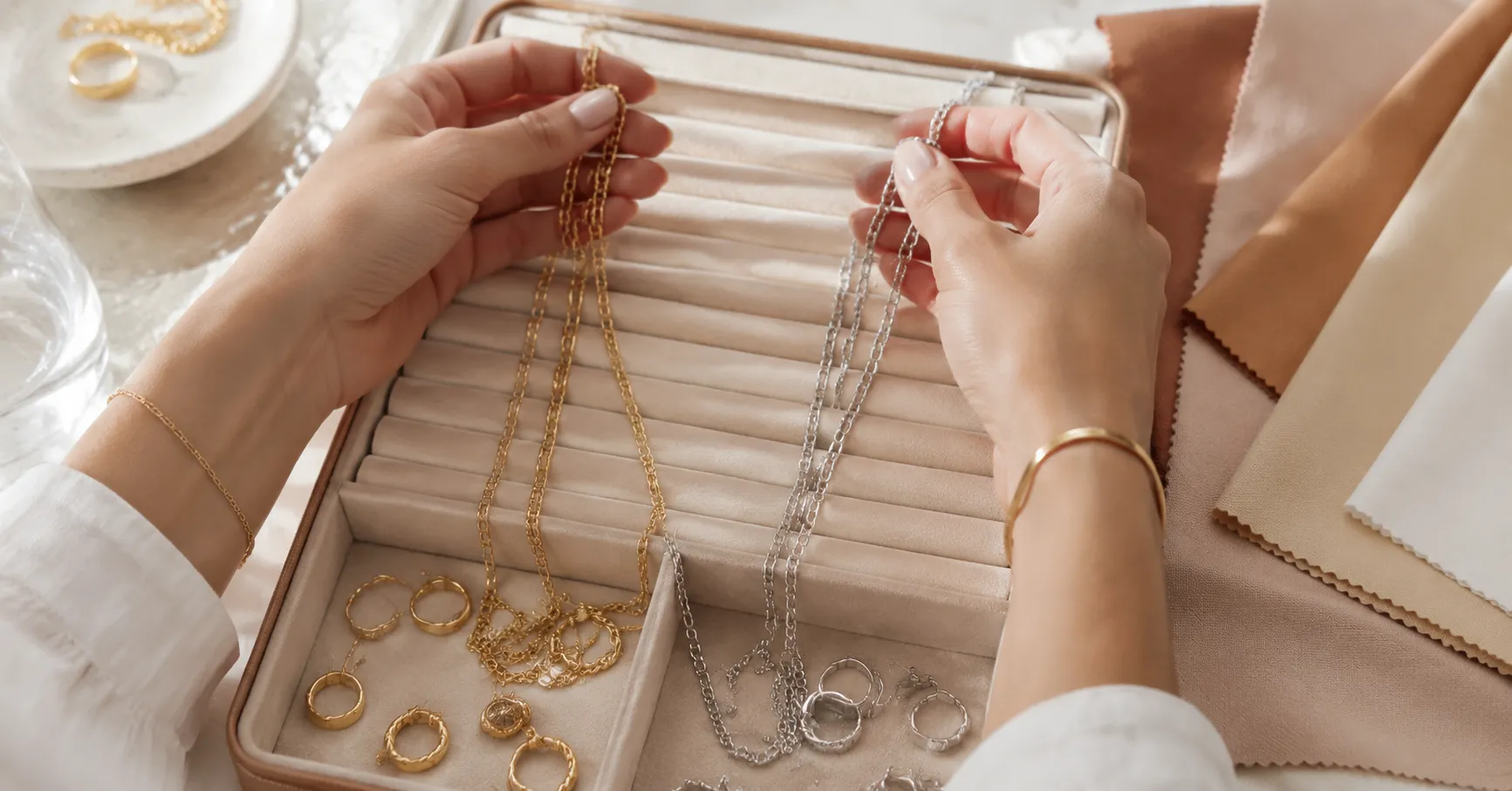
Yellow gold classic, warm, rich works in harmony with warm undertones. If your skin has golden or peachy notes, yellow gold doesn’t just sit on you; it feels like an extension of your natural warmth. The tones rhyme. Rose gold works similarly, though it adds a blush dimension that makes it particularly flattering for those with peachy or light warm complexions. It has a softness that yellow gold sometimes doesn’t.
Cool undertones, on the other hand, tend to come alive with silver, white gold, or platinum. These metals carry a clean, almost luminous quality that amplifies the natural clarity in cooler complexions. There’s a crispness to the pairing the way a well-starched collar looks against a sharp jawline.
Neutral undertones have the rare luxury of pulling from both sides. Yellow gold works. Silver works. Rose gold definitely works. If you fall here, your real challenge is learning what you personally prefer, because the physics are largely forgiving.
This doesn’t mean rules are absolute. A deep-complexioned woman with cool undertones wearing a heavy yellow gold cuff can look stunning because depth of skin tone introduces its own contrast dynamic. The interaction between metal luminosity and skin depth creates visual drama that can override the undertone logic entirely. Know the rules well enough to break them intentionally.
Stones, Colors, and the Subtler Art of Contrast
Metal is just the beginning. Once you introduce colored gemstones, the conversation becomes richer and more personal.
For warm undertones, stones with earthy, fiery, or amber depth tend to be magnetic. Think citrine, carnelian, amber, coral, deep garnet, and warm-toned turquoise. There’s a reason these stones have been used in jewelry traditions from North Africa to South Asia they were intuited, over centuries, to work beautifully against golden-brown skin.
Cool undertones find their counterparts in stones with blue, violet, or icy clarity. Sapphire, amethyst, aquamarine, blue topaz, and clear diamonds all carry that crisp luminosity. Pearls particularly white or pink-tinted varieties have long been associated with fair, cool-toned complexions for exactly this reason. The reflected light complements rather than competes.
Neutral undertones can experiment freely across the spectrum, but there’s a particular affinity for greens emerald, jade, peridot which tend to flatter almost universally because green sits at a kind of optical midpoint between warm and cool.
Skin depth adds another layer. Someone with deep, richly pigmented skin can carry stones with real visual weight large cuts, bold colors, high saturation. The contrast between skin and stone becomes a feature, not a problem. For lighter complexions, subtler stones often have more refinement; the delicacy reads as intentional.
The Often-Overlooked Role of Metal Finish
Beyond metal color, finish does genuine optical work that most people ignore entirely. A high-polish yellow gold earring reflects light differently than a brushed or hammered version of the same metal. Polished metals amplify contrast they catch the eye and create a sharper boundary against skin. Matte or satin finishes soften that edge, blending more gently.
For warm undertones, a hammered or matte gold feels particularly organic it evokes something ancient and earthy, like jewelry worn in Moroccan souks or Rajasthani markets. For cool undertones, high-polish silver or platinum creates that clean, metropolitan finish that feels contemporary and precise.
Oxidized metals darkened, antiqued, almost blackened deserve their own mention. They tend to read as warm-neutral and can look extraordinary against deeper skin tones, where the contrast becomes striking rather than jarring. Against very fair skin, they can feel heavy unless the piece itself is delicate.
Layering, Scale, and Reading the Room
Scale matters more than people admit. A petite chain on a deep complexion can get visually lost the contrast is there, but the piece is too small to create meaningful impact. Conversely, an oversized statement necklace on very fair skin can feel like it’s wearing you rather than the other way around.
When layering jewelry a practice that feels current and has real staying power as a style approach coherence in undertone becomes even more important. Mixing metals can work beautifully, but the default mode for most people should be tonal consistency. If you’re layering gold, let all the metals stay in the gold family. Mixing yellow and rose gold is more cohesive than mixing yellow gold and silver, because the warmth rhymes.
There’s also the question of occasion and skin exposure. A strapless dress reveals shoulders and décolletage more skin surface for jewelry to interact with. In that context, the undertone dynamic plays out at full volume. A winter outfit with a high collar leaves only the face and hands visible, which shifts the equation. You have less skin canvas, which means the jewelry has to do more work as a standalone visual element.
When Intuition Overrides the Framework
All of this logic is useful, but it’s worth holding loosely. Some of the most memorable jewelry moments come from friction rather than harmony a warm-toned woman wearingicy silver and making it feel like a deliberate, almost confrontational elegance. A fair-skinned person wearing deep amber coral because it makes them feel like themselves in a way no pearl ever has.
The framework isn’t a cage. It’s more like a map. You learn the terrain so you can navigate confidently, and then once you know where the boundaries are you can decide which ones are worth crossing. Style has never been just physics. It’s psychology. It’s memory. It’s the particular way a piece makes you stand differently in a room.
That necklace you put back in the box? Maybe it genuinely doesn’t match your undertone. Or maybe you just haven’t found the right dress to wear it with yet.