

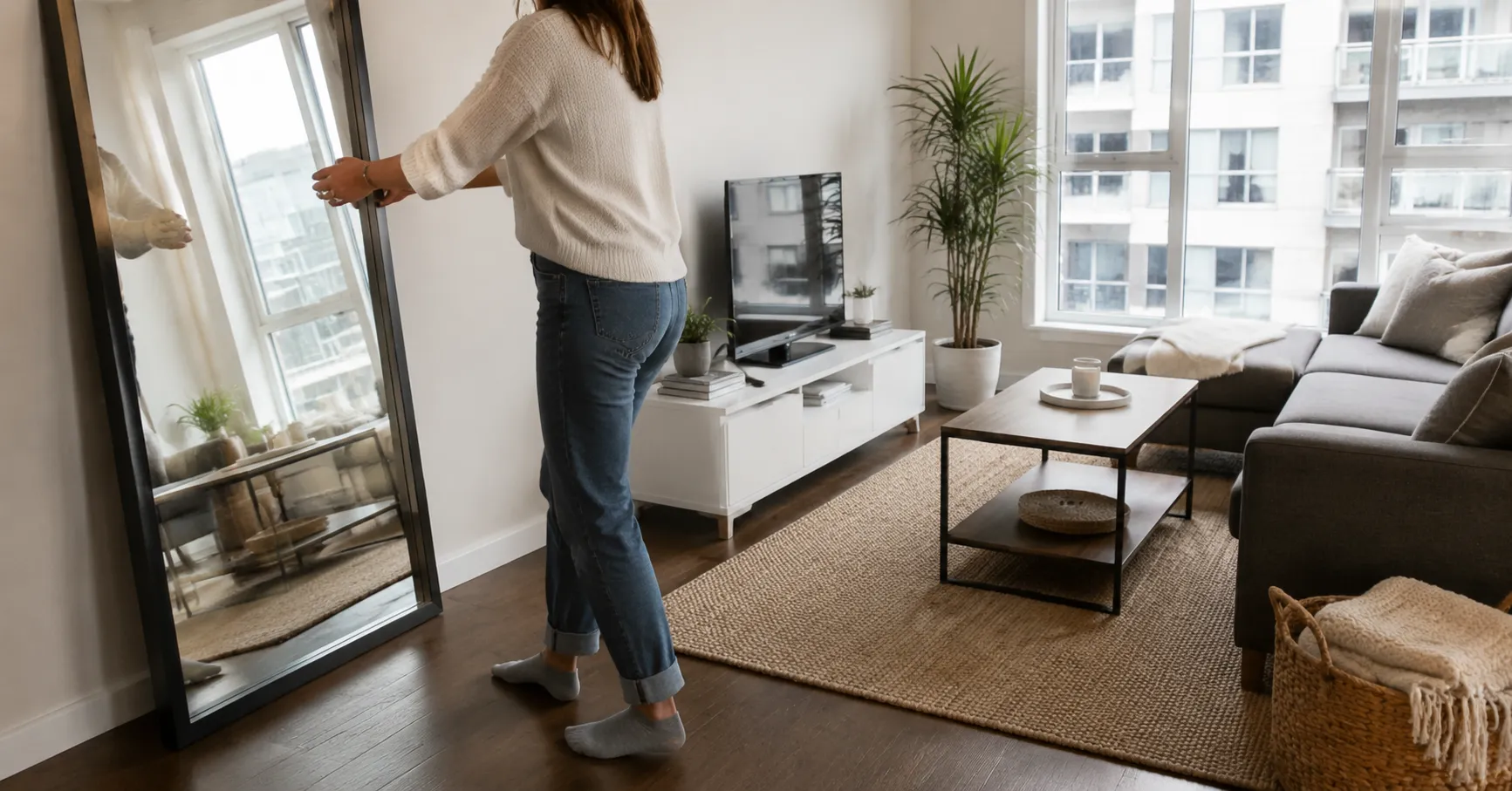
There’s a particular kind of frustration that comes with small apartment living. You arrange and rearrange, you buy the storage bins and the clever ottomans, and still the place just feels like it’s closing in. The walls aren’t actually moving, of course, but your perception of space is being shaped by dozens of small decisions you probably made without thinking: the sofa that sits too far from the wall, the curtains that hang too low, the bookshelf crammed with objects competing for your eye’s attention.
The good news is that perception is malleable. The way a room feels has less to do with square footage than with how light moves through it, how your gaze is directed, and how much visual noise the space contains. You don’t need to knock down walls or hire a contractor. What you need is a different way of seeing and then a systematic willingness to act on it.
Light Is the First and Most Powerful Tool
Before you move a single piece of furniture, look at your windows. Really look at them. Most people hang curtains at the window frame, which is intuitive but spatially destructive. When curtain rods sit at frame height, your eye registers the window as a defined, contained box and by extension, the room as bounded.
Raise the rod to within a few inches of the ceiling, and let the curtains fall all the way to the floor. This does two things simultaneously: it draws the eye upward, elongating the apparent height of the room, and it frames the window in a way that suggests the wall is mostly glass, mostly open. Natural light floods further into the space rather than being partially blocked by fabric that starts mid-wall.
Color temperature matters too. Warm, yellowish lighting creates coziness which is fine in a den, but in a small apartment it can make the air feel thick and close. Switch overhead bulbs to a cooler, brighter temperature (somewhere around 3000–4000K works well for living spaces), and supplement with floor lamps that push light toward the ceiling. Uplighting creates the sensation of a taller room almost immediately.
Mirrors Are Not a Gimmick
Interior design articles have been recommending mirrors for decades, and people still underutilize them usually because they place one mirror in one spot, watch it do nothing dramatic, and give up. The effect depends on placement, not just presence.
A large mirror positioned directly across from a window doesn’t just reflect light; it creates what reads to your brain as a second window. Your subconscious doesn’t fully distinguish between an aperture and its reflection, so the room registers as having more exits, more openings, more air. A single full-length mirror leaned casually against a wall does measurably less than one hung deliberately at eye level across from a natural light source.
Groupings of smaller mirrors can work similarly when arranged on a single wall, but the key is treating them as one coherent element rather than a scattershot collection. Matching frames, consistent spacing, unified intention.
Furniture Proportion Is Everything
Walk into most cramped apartments and you’ll notice the same pattern: furniture that was chosen for function or price rather than proportion. A sectional sofa that seemed reasonable in a showroom eats three-quarters of the living room. A king bed leaves six inches of floor on either side, making the bedroom feel like a hallway.
Scale down. This doesn’t mean buying cheap or sparse furniture it means buying furniture that fits the spatial math of the room. A well-proportioned apartment with a medium sofa, a small dining table, and breathing room around each piece feels more generous than an overstuffed space where every square foot is occupied.
Legs help more than most people expect. Furniture that sits directly on the floor creates a heavy, grounded presence that visually divides the room. Sofas, chairs, and even beds raised on visible legs allow light and sightlines to pass underneath, which the eye reads as continuity rather than obstruction. It’s a small thing, and it consistently makes a room feel roomier.
One more thing about furniture: don’t push everything against the walls. This seems counterintuitive pulling pieces away from the walls leaves less open floor space, technically but it actually creates a more composed, breathable arrangement. Furniture floating slightly from the perimeter encourages the eye to move around the space rather than racing along the edges.
Color and the Psychology of Depth
There’s a persistent myth that small rooms must be white. It’s not wrong exactly, but it’s an oversimplification that leads people to live in sterile, flat spaces that they find oddly joyless. The real principle isn’t about white it’s about light reflectance and visual continuity.
A pale, muted color used consistently across walls and ceiling can actually make a room feel more expansive than stark white, because it removes the contrast line between vertical and horizontal surfaces. When your eye can’t easily identify where the wall ends and the ceiling begins, the room reads as more continuous, more open. Off-whites, pale greiges, and soft sage greens do this well.
Dark accent walls can work, but they require commitment. A single dark wall in a small room needs to be the deliberate focal point, with everything else restrained and light. Half-measures one slightly darker wall that wasn’t quite intentional just make the room feel uneven.
Floor color matters too, though it’s often overlooked. Rugs that are too small create visual fragmentation; a properly sized rug that extends under the front legs of all the main furniture ties the seating area together as a zone, which paradoxically makes the surrounding open space feel more intentional and therefore larger.
Vertical Space Is Almost Always Wasted
Most apartment dwellers stop decorating at eye level. Shelving, art, and storage cluster in the middle third of the wall, leaving everything above empty and everything at floor level functionally dead. This is spatially wasteful in a way that’s easy to fix.
Built-in shelving isn’t the only way to go vertical. A standard bookcase extended with a second unit stacked on top reaches near the ceiling and draws the eye upward. Art hung high higher than feels natural the first time encourages the gaze to move through the full height of the room. Plants placed on tall stands or hung from the ceiling add life without consuming floor space, which is the most precious real estate in a small apartment.
Vertical storage also solves the clutter problem, which is inseparable from the space problem. Visual clutter is one of the primary forces that makes a room feel small the brain reads disorder as density, as closeness. When storage goes upward, surfaces stay clear, and clear surfaces make rooms breathe.
Declutter Without Minimalism Dogma
Here’s where a lot of small-apartment advice goes sideways: it tells you to minimize, to pare down, to live with less. For some people that’s liberating. For others it strips the personality from a home and makes it feel like a hotel room they’re temporarily occupying.
The more useful distinction isn’t between having things and not having things it’s between objects that have a place and objects that are just sitting there. A shelf of carefully arranged books with a few meaningful objects interspersed reads as intentional. The same books with papers, charger cables, half-used candles, and last year’s sunglasses reads as chaos. Same number of objects, completely different spatial effect.
Storage that hides doesn’t eliminate it contains. Baskets, closed cabinets, and furniture with built-in storage shift the visual field from scattered to composed. The room doesn’t get bigger, but it stops actively convincing you it’s small.
There’s something almost philosophical in all of this. A small apartment isn’t a problem to be solved through money or renovation. It’s a spatial puzzle that responds to attention to the slow, deliberate work of noticing what your eye does when it moves through a room, and then adjusting, carefully, until the room starts to feel like it’s working with you rather than against you.