

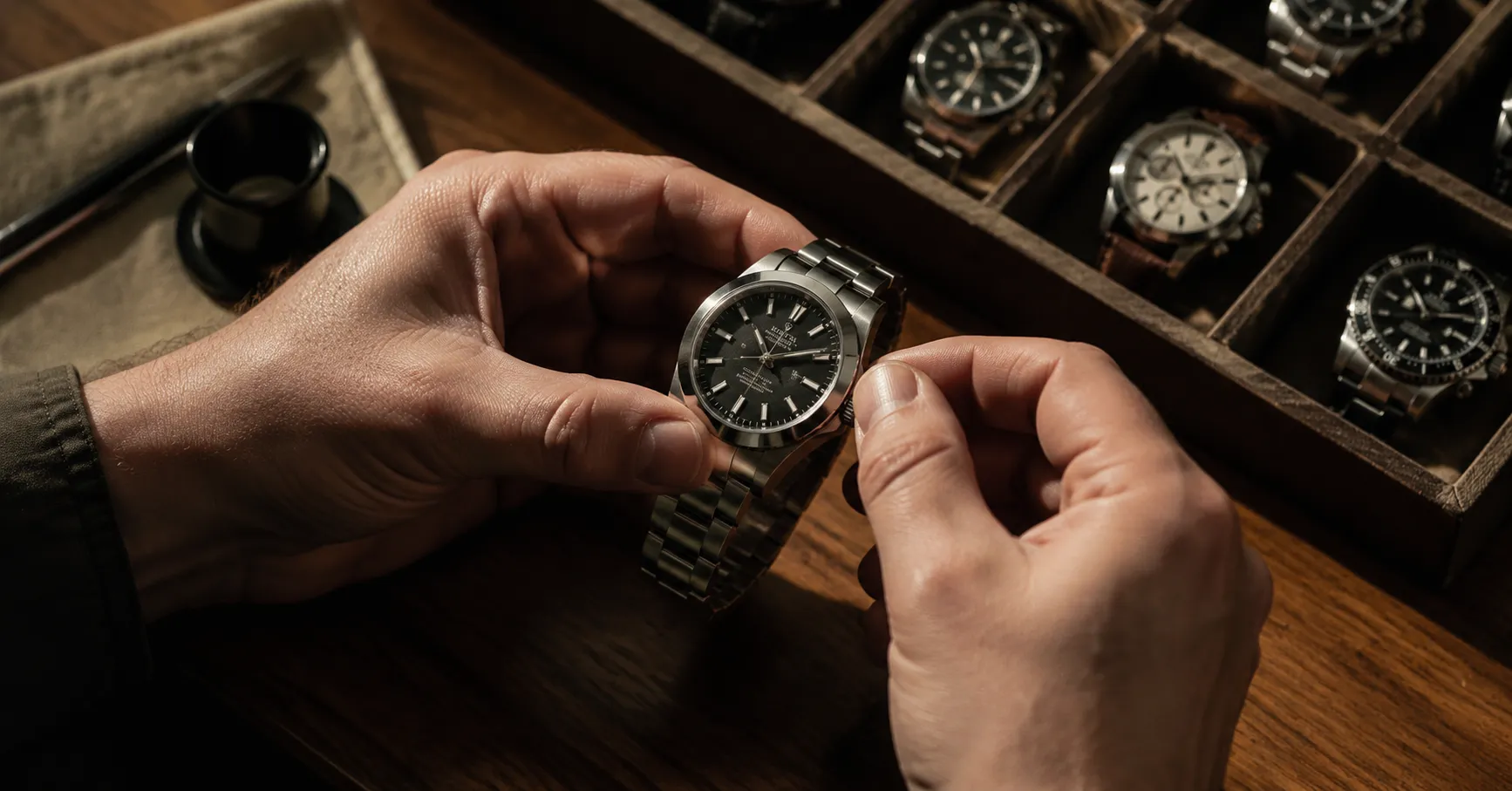
There’s a moment every watch buyer knows. You’re holding a piece in your hand or staring at it through a display case and something about it just feels off. Or feels right. You can’t always name it immediately, but the signal is there. Learning to read that signal fluently is the difference between someone who collects watches and someone who simply buys them.
The good news is that quality in a watch is not as mysterious as the industry sometimes wants you to believe. It leaves traces everywhere. In the weight, the finish, the sound of the crown, the way the hands catch light. Once you know what you’re looking for, a high-quality watch becomes unmistakable and so does the pretender sitting next to it.
Start With the Case Finishing
Run your eyes along the case before you do anything else. A well-made watch will show two distinct surface treatments working in deliberate contrast: polished sections that reflect like a mirror, and brushed sections with a fine, directional texture. The line where these two finishes meet should be razor-sharp. No bleeding, no blur, no gradual transition. That crisp edge is one of the clearest signals of careful hand-finishing, and it’s genuinely difficult to fake at scale.
Cheap watches often use fully polished cases because it’s easier to machine. They can look flashy in photos, but under direct light, you’ll notice unevenness micro-scratches, slightly warped reflections, surfaces that don’t quite align. Higher-end brands spend serious time on this step because they know it’s what separates a watch that photographs well from one that holds up to scrutiny in real life.
Look at the lugs especially. On quality pieces, the transition from lug to case follows a logical, intentional geometry. On lesser pieces, it often looks like someone approximated that geometry and hoped you wouldn’t notice.
The Crown and Pushers Tell You a Lot
Pick up the watch and interact with the crown. Unscrew it if it’s a screw-down crown. The resistance should feel smooth and deliberate there’s a particular satisfying friction to a well-made crown that’s hard to describe but easy to recognize. Extend it to the first position and turn it. You’re listening for silence, or something close to it. A faint, consistent click as the mechanism engages is acceptable and often desirable. What you don’t want is grinding, looseness, or a feeling like the crown is slightly too large or too small for its own threading.
The gap between the crown and the case matters too. It should look intentional, not like tolerances were missed. On a good watch, this relationship looks engineered. On a poor one, it looks assembled.
If the watch has chronograph pushers, press them. The resistance should feel consistent on both. The sound on release should be a clean snap, not a thud or a rattle.
Reading the Dial Like a Document
The dial is where a brand tells you who they are, and they can’t hide much. Look at the printing first. Text on a quality dial is impossibly crisp the serifs on each letter, if there are serifs, maintain their form at small sizes without any bleeding into the lacquer. The numerals or indices should be perfectly positioned. Not approximately centered. Centered.
Applied indices those are the raised hour markers attached directly to the dial are a strong signal of quality. They require more labor to install and align correctly, and they catch light in three dimensions in a way that printed markers simply can’t. If the indices are applied, check that they sit level and that the adhesive isn’t visible from any angle.
Lume, the luminous material applied to hands and indices, is another tell. On a quality watch, lume is applied evenly and fills the surface it’s meant to fill. On cheaper pieces, it looks like someone used a fine-tip pen to dab paint and moved on. You’ll sometimes see lume that’s lumpy, that has pulled away from edges, or that varies noticeably in thickness from one marker to the next.
The dial surface itself deserves attention. Sunburst and guilloche dials where the surface is textured through mechanical engraving have a depth that changes with your viewing angle. As you tilt the watch, the color seems to shift, darkening at the center and brightening outward, or the reverse. That effect is not a trick. It’s geometry, and it takes real tooling to produce.
Weight, Balance, and What They Suggest About the Movement
A quality watch has a presence in the hand. Not just heaviness though many quality pieces are substantial but balance. It sits on the wrist the way it’s supposed to, without pulling toward one side or feeling top-heavy.
The movement inside accounts for much of this. Swiss and Japanese mechanical movements, even at entry-level price points for those respective categories, are built with tolerances that translate to tactile density. A watch running a quality movement simply feels coherent. The mass is distributed by design, not by coincidence.
If you can view the movement through a caseback, you’re entering deeper territory. Look at the finishing on the bridges and plates. A movement worth owning will have Geneva stripes (those parallel lines across the surfaces), beveled edges on the bridges, and screws with polished heads. The blued screws you see on many fine Swiss movements aren’t just decorative they’ve been heat-treated to that color, which also increases hardness. That’s two functions solved with one process. That kind of thinking runs through quality watchmaking at every level.
Poorly finished movements look busy and unresolved. The surfaces are flat, the components don’t have consistent edge treatments, and the overall impression is of something assembled rather than crafted.
The Bracelet or Strap Is Not an Afterthought
Too many buyers fall in love with the dial and ignore what connects the watch to their wrist. On an integrated bracelet, look at the links. They should articulate smoothly, following the curve of your wrist without any link sticking, rattling, or sitting at an odd angle to its neighbor. The brushed and polished finishing that applies to the case should continue consistently through the bracelet same sharpness, same intentionality.
Clasp deployment is a reliable quality indicator. Press the release on a good bracelet and it opens with a single, clean motion. The butterfly clasp on quality pieces closes with a satisfying snap that you can feel as much as hear. Cheap clasps feel like they’re tolerating being opened and closed. Quality clasps feel like they were designed to do exactly this, indefinitely.
On leather straps that come with higher-end pieces, check the stitching not just on the front, but underneath. The padding should be consistent end to end, and the taper of the strap should be gradual and even. Astrap that looks great from the top but has rough, irregular stitching on the back is a factorystrap on a production budget.
The Sapphire Question
One practical test almost anyone can do in a store: bring a breath to the crystal. Sapphire crystal the standard on serious watches repels moisture. Breathe on it and the fog dissipates in a second or two. Mineral glass holds that fog notably longer. This isn’t a definitive quality test on its own, but it confirms what the spec sheet is likely telling you.
The coatings applied to sapphire are another differentiator. Anti-reflective coating on the inside of the crystal kills glare and lets you see the dial clearly from steep angles. On quality pieces, this coating is usually multilayer and nearly invisible, giving the dial that slightly green or blue tint you see only when light catches it straight on. On budget crystals, AR coating can look uneven, creating a faint oil-slick effect.
Time Is the Final Filter
Here’s the thing about truly high-quality watches: they reward long acquaintance. The longer you wear one, the more details you notice. The way the handset aligns precisely at6 o’clock. The way the case back inscription sits at a specific orientation when closed. The feel of the crown at3 o’clock through a shirtcuff.
Cheap watches tend to work the other way. They look their best in the first moment and slowly reveal their compromises. A hairline scratch shows up earlier than expected. The lume fades unevenly. The strap cracks at the first hole.
The ability to hold your attention over time isn’t just an aesthetic quality. It’s the end result of every decision made upstream the case finishing, the movement specification, the dial printing, the bracelet construction. High-quality watchmaking is really just consistent decision-making, all the way down, by people who understood that someone would eventually look closely.