
There’s something almost unfair about how a single accessory can reframe an entire outfit. You’ve probably experienced it standing in front of the mirror in a dress or a pair of trousers that feels somehow unfinished, then cinching a belt around your waist and suddenly everything clicks. The proportions sharpen. The fabric behaves. You look like you got dressed with intention.
Belts do this better than almost any other accessory, and the reason isn’t mystical. It’s architectural. Clothing is essentially fabric shaped around a body, and belts are the one tool that lets you actively manipulate that shape in real time. A great belt doesn’t just hold your pants up it edits your silhouette, signals your aesthetic sensibility, and communicates a level of care that reads, to the trained eye, as expense.
The question is: which belts actually do this, and why?
The Width Equation
Width is the first variable most people overlook. Walk into any fast fashion store and the belts tend to cluster around the same1-inch skinny silhouette thin enough to feel like an afterthought, which is exactly how they read on the body.
Wider belts, particularly in the 2.5 to 3.5 inch range, carry an entirely different visual weight. They were a staple of tailored fashion in the 1950s and ’60s for a reason: they anchor the waist with authority. When worn over a blazer or a loose linen shirt, a wide belt transforms the entire composition from “I got dressed” to “I styled this.” The visual logic is simple a wider belt demands more attention and thus signals more deliberateness.
That said, width isn’t a universal upgrade. A wide belt on a petite frame can overwhelm rather than define. The sweet spot for most body types tends to be somewhere between 1.5 and 2.5 inches substantial enough to register as intentional, narrow enough to stay versatile. It’s that specific range where belts start earning their keep.
Leather That Actually Looks Like Leather
Material is where cheap belts reveal themselves almost instantly. There’s a quality of light that real leather has a subtle variation in surface texture, a slight depth that bonded leather and synthetic alternatives simply cannot replicate. Genuine leather develops a patina over time, which is to say it gets better looking as it ages. A scratch on a real leather belt becomes character. A scratch on a PU belt becomes damage.
Full-grain leather is the gold standard. It retains the natural grain of the hide, which means every belt has a slightly unique texture. The edges, when properly finished and burnished, have a smooth, almost polished quality rather than the raw, painted look of cheaper options. If you pick up a belt and the edges look like they’ve been colored with a marker and left to dry, put it down.
Vegetable-tanned leather deserves a specific mention here. It’s produced using tannins from plant materials rather than synthetic chemicals, which results in a firmer, denser leather that stiffens slightly with wear and molds gently to your body. Brands that use vegetable-tanned leather tend to shout about it, because it justifiably commands a premium. The visual result rich, deep color, clean edges, natural variation is unmistakable.
For those who prefer not to wear animal products, high-quality Piñatex or other structured vegan leathers can work, but be selective. The failure mode of vegan leather belts is usually at the buckle attachment point, where they crack or peel under stress. A well-constructed vegan leather belt with reinforced stitching at stress points can absolutely read as elevated.
The Buckle as Punctuation
If the belt is a sentence, the buckle is the period or the exclamation point, depending on your choices. Buckle design is where belts either earn or lose their expensive credibility.
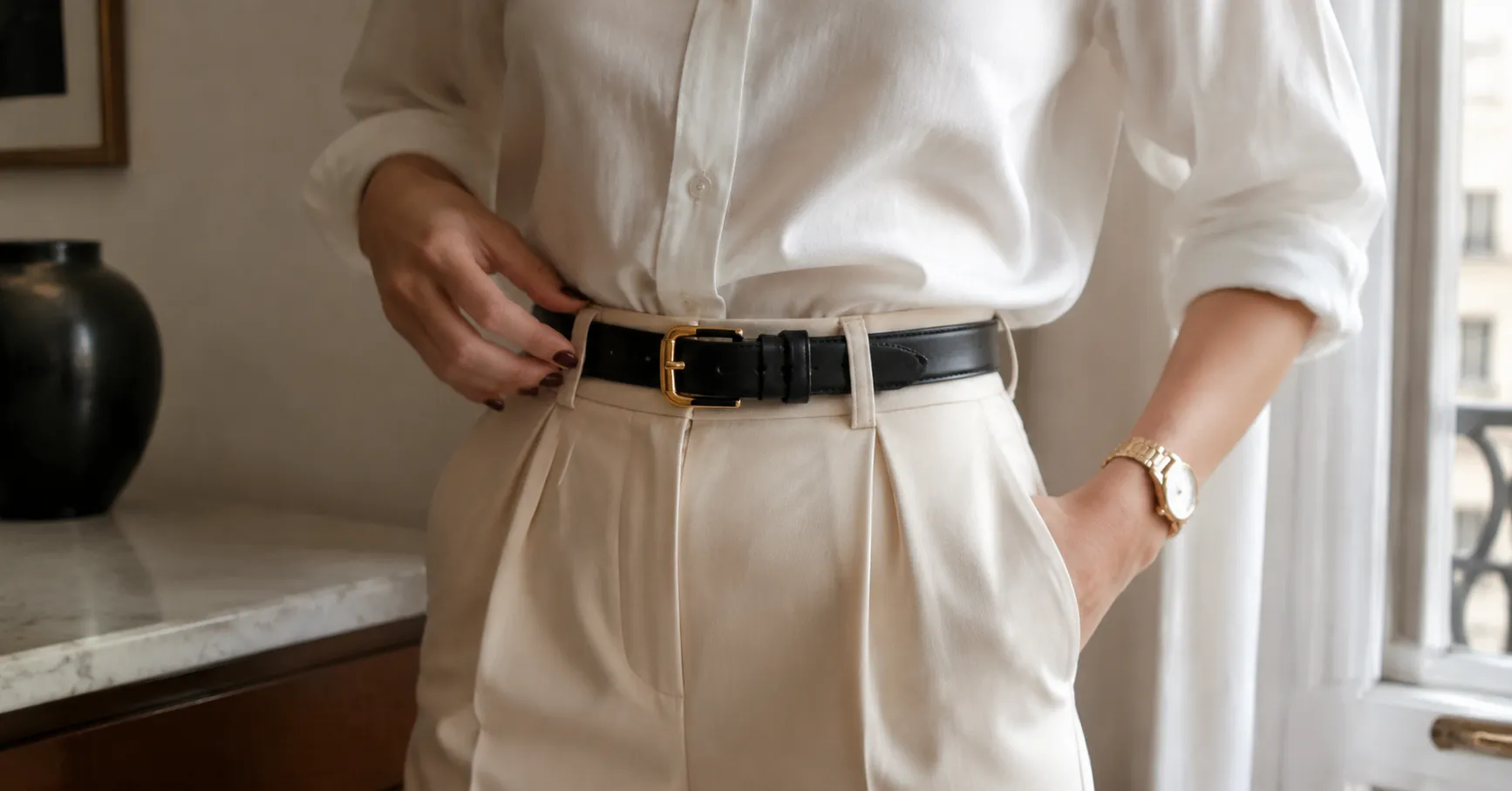
Minimalist hardware in a single, consistent metal finish brushed gold, antique silver, oxidized brass reads as intentional and expensive. The logic here parallels what interior designers call “hardware consistency”: when the metal tones in a room all speak the same language, the space feels considered rather than assembled. The same principle applies to an outfit. A brushed gold belt buckle that echoes the gold hardware on a handbag or a pair of earrings ties the whole look together in a way that’s felt before it’s consciously noticed.
Oversized logo buckles are a more complicated conversation. On the right belt genuine leather, beautiful construction a recognizable logo can register as an intentional status signal. On a poorly made belt, the same logo reads as compensation. The buckle is drawing attention to itself precisely because everything else can’t hold it. When in doubt, clean and simple almost always outperforms loud.
Frame buckles the rectangular, open-bar style have a particular elegance that’s held up across decades of fashion. They lie flat, they don’t snag, and they have a structural simplicity that pairs well with both tailored and casual dressing. If you’re building a belt collection from scratch, a frame buckle in a neutral metal is arguably the highest ROI choice you can make.
Color Logic and the Neutral Multiplier
There’s a temptation to reach for a statement belt in a bold color or graphic print, and occasionally that instinct serves an outfit brilliantly. But the belts that genuinely elevate the most outfits over time tend to live in a very specific color range: cognac, camel, chocolate brown, black, and off-white.
These tones work because they function as neutrals they don’t compete with the clothing, they complete it. A cognac leather belt with a pair of navy trousers and a cream blouse creates a tonal warmth that makes the entire outfit feel cohesive and intentional. The same outfit with a bright red belt becomes about the belt, which may or may not be what you want.
Cognac specifically has had a remarkable run as the belt color that reads as most expensive to the contemporary eye. It photographs warmly, it pairs with virtually every neutral, and it has just enough depth to feel deliberate without being austere. If you own one belt, a cognac or warm tan leather in a medium width is probably the one that punches furthest above its price point.
Proportion and Placement
Even the most beautiful belt can be undermined by where and how it’s worn. Placement changes proportion, and proportion is the language of expensive dressing.
Wearing a belt at the natural waist roughly an inch above the hip bone, at the narrowest point of the torso creates the most universally flattering silhouette. It’s also the placement that reads most intentionally styled. Dropping a belt down to the hip, unless you’re deliberately referencing a specific aesthetic, tends to make clothing look sloppy rather than relaxed.
The phenomenon of the “half-tuck” has revealed something interesting about proportion: when you pull fabric through a belt loop or tuck a shirt partially rather than fully, the belt becomes part of the styling story rather than just a functional fastener. The belt is visible, the tension between tucked and untucked creates visual interest, and the whole thing looks assembled rather than accidental.
Belts worn over outerwear a trench coat, an oversized blazer, a wool coat have a particular power. They transform shapeless volume into deliberate structure. This is the trick that makes a €60 coat look like a €400 coat. The belt is doing narrative work, telling the eye “this silhouette is chosen, not just worn.”
The Investment Calculus
Here’s the honest version of this conversation: a truly well-made belt full-grain leather, quality hardware, clean construction will cost between $80 and $200 from a reputable maker. That sounds like a lot until you do the math over time. A belt at that quality level will last a decade with minimal care. The cost-per-wear becomes almost negligible, and the visual return compounds: as the leather develops its patina, it actually looks better, not worse.
The belts that look cheap aren’t always cheap belts. Plenty of expensive belts look cheap because they’re over-designed, poorly proportioned, or made from materials that don’t age well. And plenty of modestly priced belts from heritage workwear brands, from artisanal leather goods makers who sell direct look quietly expensive because they’re made correctly.
What you’re really paying for, or looking for, isn’t a brand name or a price tag. It’s the quality of decisions made at the design and construction level decisions about width, material, hardware, edge finishing, and proportion. When all of those decisions are made well, the belt doesn’t announce itself. It just makes everything around it look better.
That quiet competence is, ultimately, what expensive things feel like. Not loud. Not insistent. Just unmistakably right.